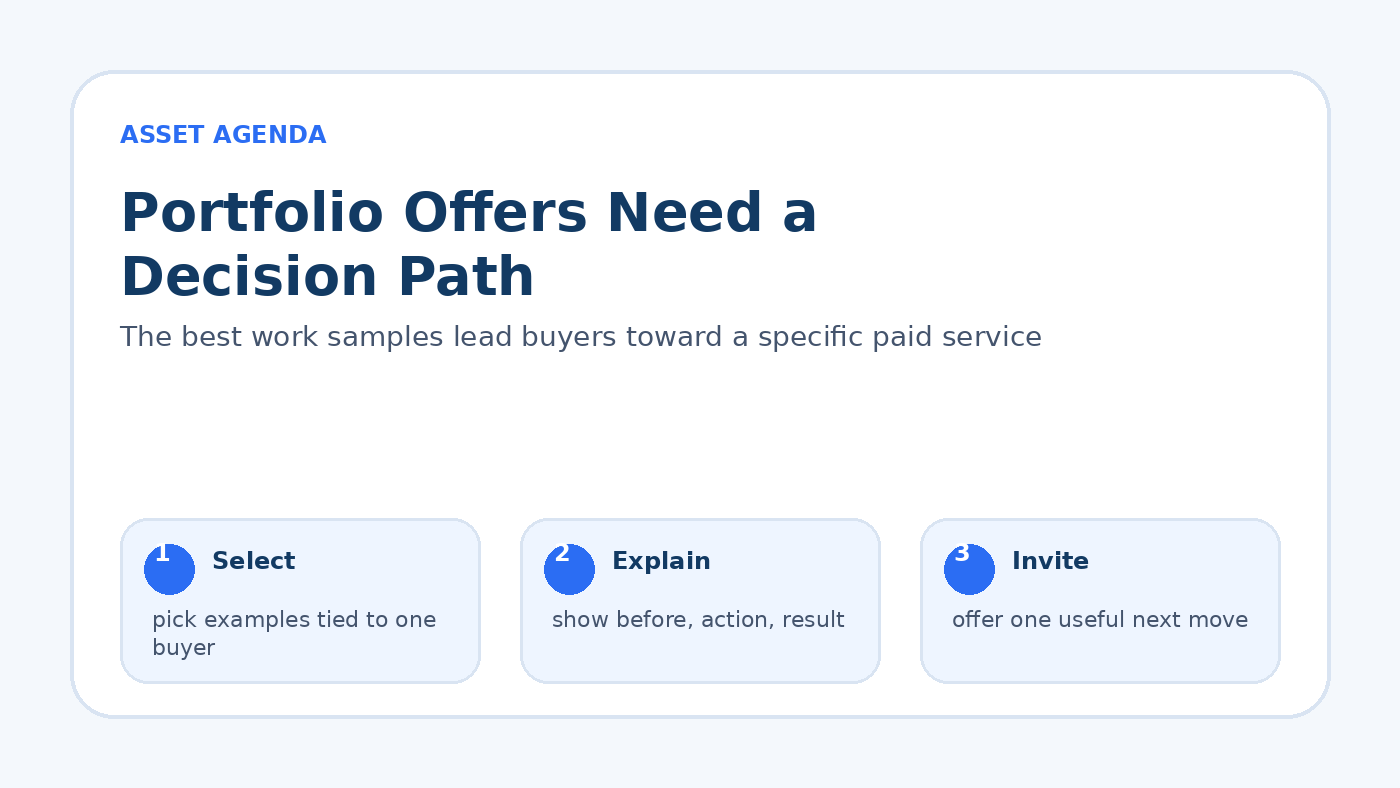
A portfolio can look polished and still fail at its real job. The problem is usually not the screenshots, testimonials, or design. The problem is that the buyer sees evidence of work but does not see a clear offer to buy.
A simple portfolio offer helps freelancers and consultants turn proof into a focused service package with a plain next step.
This guide is for solo operators who already have examples, client wins, samples, or strong practice work, but whose portfolio mostly says “look what I can do” instead of “here is the specific result I can help you get.” That tiny shift matters. Buyers do not want to decode your entire professional identity while drinking coffee and ignoring twelve browser tabs.
What a portfolio offer is
A portfolio offer is a packaged service built around the strongest pattern in your past work. It connects three things:
- the buyer type you serve best
- the painful problem they already recognize
- the paid service that moves them toward a better outcome
Instead of showing every project equally, your portfolio becomes a sales path. The work samples prove credibility, the offer explains what someone can buy, and the call to action tells them what happens next.
Why normal portfolios underperform
Most freelancer and consultant portfolios are built like museums. The visitor can wander around, admire the exhibits, and leave without making a decision. That feels professional, but it often creates weak sales momentum.
The common gaps are simple:
- too many unrelated services on one page
- project descriptions that explain tasks instead of business outcomes
- no clear starting package for a cautious buyer
- calls to action that only say “contact me”
- no reason to act now beyond vague interest
A buyer should not have to guess whether you write landing pages, set up lead systems, design brand assets, improve operations, or advise on sales follow-up. If the page makes them work too hard, they leave. Rude, but fair.
Step 1: Pick one buyer and one buying situation
The fastest improvement is narrowing the page around one real buying situation. You are not deleting your other skills forever. You are giving one group of buyers a clean path.
Examples:
- a designer helping local service businesses refresh dated websites
- a copywriter helping consultants improve sales pages
- an operations consultant helping small teams clean up client onboarding
- a marketing freelancer helping creators set up email funnels
- a CRM specialist helping businesses organize leads and follow-up
Notice that each example includes a person, a problem, and a useful outcome. That is stronger than “I offer strategy, design, writing, and automation.” Accurate, sure. Helpful, barely.
Step 2: Turn proof into case-study style blocks
Your portfolio examples should not only show the finished work. They should explain why the work mattered. Use a simple three-part structure for each featured sample:
- Before: what was confusing, slow, costly, or missing?
- Work: what did you change, build, write, organize, or improve?
- After: what became clearer, faster, easier, or more measurable?
You do not need dramatic numbers for every project. Clear operational results still count. “Reduced onboarding confusion,” “made the offer easier to understand,” and “gave the team one follow-up process” are useful outcomes when they are honest and specific.
Step 3: Package the entry offer
A strong portfolio offer gives the buyer a safe first step. That usually means a focused package, not a massive custom engagement.
Good entry offers might look like:
- a website conversion review with a prioritized fix list
- a landing page rewrite for one offer
- a two-week client onboarding cleanup
- a lead follow-up audit and message sequence
- a portfolio positioning sprint for another freelancer
The offer should include the outcome, scope, timeline, deliverables, and starting price or price range if you are comfortable publishing it. If you are not publishing price, at least explain what affects scope so buyers know whether they are in the right neighborhood.
Step 4: Add a stronger next step than “contact me”
“Contact me” is not wrong. It is just weak. A buyer who is interested still wants to know what happens after they click.
Use a call to action with a specific promise:
- Request a portfolio-fit review
- Book a 20-minute project fit call
- Send your current page for a quick scope estimate
- Ask for the onboarding cleanup checklist
- Get a quote for one focused improvement sprint
If you use a CRM or automation platform, this is where a simple intake form and follow-up sequence helps. A tool like GoHighLevel can work for businesses that need forms, pipelines, reminders, and follow-up in one place, but the strategy comes first. Software should support the offer, not rescue a vague one.
Step 5: Build the page around buyer questions
A good portfolio offer page answers the questions buyers already have in their head:
- Do they understand my kind of business?
- Have they solved a similar problem?
- What exactly can I buy?
- How long does it take?
- What do they need from me?
- What happens if I am not ready for a bigger engagement?
Use those questions as section headings or short blocks. This makes the page easier to scan and better aligned with search intent for people comparing freelance help, consultant services, or service packages.
A simple portfolio offer outline
Use this structure if your current portfolio feels scattered:
- Headline: name the buyer and outcome.
- Intro: explain the problem you solve in plain language.
- Featured proof: show two or three relevant examples.
- Offer: describe the focused package.
- Process: explain how the work moves from intake to delivery.
- FAQ: answer fit, timing, price, and revision questions.
- Next step: invite one clear action.
This outline works because it respects how buyers make decisions. They need trust, relevance, clarity, and a low-friction path forward.
What to avoid
A portfolio offer should stay practical and believable. Avoid promising guaranteed revenue, pretending every project has giant results, or stuffing the page with every skill you have ever touched. Confidence is good. Carnival-barker energy is not. We are selling services, not launching fireworks in a spreadsheet.
Also avoid hiding your best proof behind vague labels like “Project 01” or “Brand System.” Use descriptive names that help buyers self-identify, such as “Landing Page Rewrite for a B2B Consultant” or “Client Onboarding Cleanup for a Small Agency.”
FAQ
How many projects should a freelance portfolio show?
For a focused offer page, two to four highly relevant examples are usually better than ten mixed samples. The goal is to prove fit for one buyer situation, not show your entire career archive.
Should freelancers list prices on a portfolio page?
Listing a starting price or price range can filter weak-fit inquiries and make serious buyers more comfortable. If pricing varies, explain the main factors that change scope.
Can a consultant use this if they do not have visual work?
Yes. Use process snapshots, anonymized before-and-after examples, diagrams, written case studies, or clear operational outcomes. Proof does not have to be visual to be useful.
The bottom line
A simple portfolio offer turns your best work into a buying path. Pick one buyer, show proof that matches their problem, package a focused service, and give them a clear next step. That is how a portfolio stops being a gallery and starts acting like a quiet little sales assistant. Much cheaper than hiring a tiny person to live inside your website.
Want a clear next step?
Read the simple retainer offer guide ->