A lead magnet can collect names, but it does not create revenue by itself. The real value appears after someone downloads the checklist, calculator, template, or mini-course and then receives a useful next step.
A simple lead magnet follow-up system helps online businesses turn new subscribers into educated prospects without sounding pushy or pretending every reader is ready to buy today.
This guide is for creators, consultants, course sellers, affiliate publishers, service providers, and small teams that already have an audience touchpoint and want a calmer way to move people from interest to action.
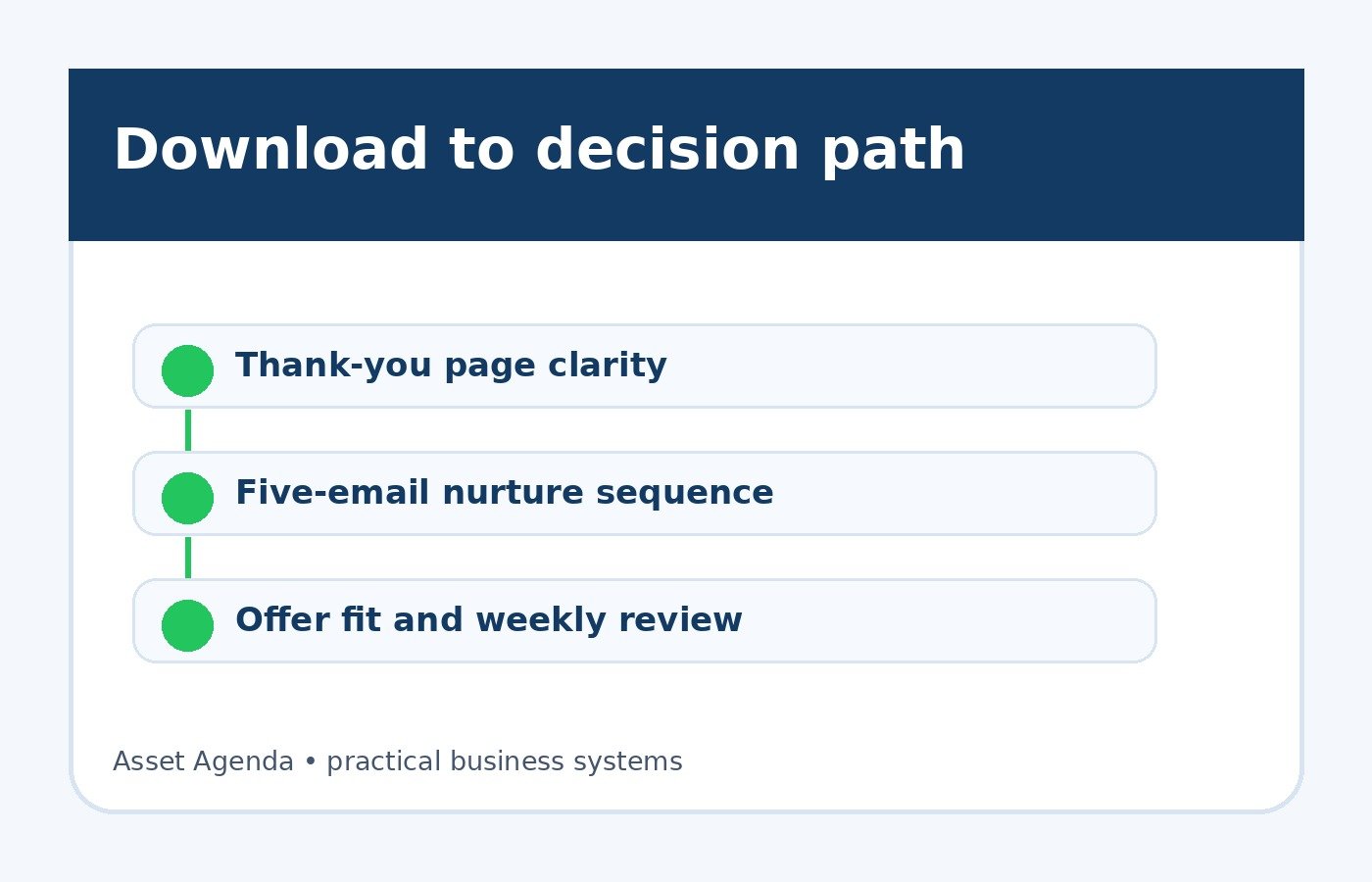
What a lead magnet follow-up system is
A lead magnet follow-up system is the short sequence that happens after someone joins your email list or contact list to get a free resource. It confirms the request, gives them the item, explains how to use it, builds trust, and points them toward the most relevant paid next step.
Without follow-up, the lead magnet becomes a lonely file sitting in someone's downloads folder. The subscriber may like the resource, but they never see your deeper offer, your best examples, or the practical reason to keep listening.
The goal is not to flood people with sales messages. The goal is to help a new contact understand the problem, use the resource, and decide whether your offer fits.
Why most lead magnets underperform
Lead magnets usually fail for simple reasons. The resource is too broad. The thank-you page has no clear next step. The first email only says, “here is your download.” Then the business disappears for two weeks and returns with a random promotion.
That creates a gap between interest and trust. A better system closes the gap with useful timing:
- Send the promised resource right away.
- Show the person how to get a quick win from it.
- Explain the mistake the resource is meant to prevent.
- Share a real example or buyer situation.
- Make one clear invitation instead of six scattered offers.
The five-email lead magnet follow-up sequence
You do not need a giant automation map to begin. A five-email sequence is enough for many online businesses.
Email 1: deliver the resource
Send the lead magnet immediately. Keep the subject simple and make the download link obvious. Add one sentence explaining what they should do first.
Example: “Start with page two and choose the one bottleneck that is costing you the most time this week.” That is more useful than handing over a file with no direction.
Email 2: explain the quick win
The second email should help the reader use the resource. Give them a small action that can be finished in ten to twenty minutes.
If the lead magnet is a pricing checklist, the quick win might be reviewing one offer. If it is a funnel worksheet, the quick win might be choosing one conversion point to improve. If it is a local lead checklist, the quick win might be fixing the first response message.
Email 3: show the common mistake
People often need help seeing why the problem matters. Use this email to name the mistake that keeps them stuck. Keep it specific.
For example, a consultant may collect leads but never explain what happens after the first call. A creator may build a free guide but forget to connect it to a paid product. A local service business may get inquiries but wait too long to follow up.
Email 4: give proof or a practical example
This email should make the idea feel real. Share a before-and-after example, a short case-style breakdown, or a practical scenario.
You do not need dramatic claims. A calm example works better: “A freelancer with three scattered offers can use one lead magnet to sort readers into beginner, implementation, and done-for-you paths.”
Email 5: make one offer invitation
The final email in the first sequence should invite the reader to one next step. That might be a consultation, paid template, course, software guide, affiliate recommendation, membership, audit, or service package.
Do not attach every possible offer. Choose the offer that best matches the problem the lead magnet introduced.
What to put on the thank-you page
The thank-you page is often wasted. It should not be only a sentence saying the resource is on the way. Use it to reduce confusion and create momentum.
- Confirm what they requested.
- Tell them to check their inbox.
- Explain the first action to take with the resource.
- Offer one optional next step for people who want help sooner.
If the lead magnet is related to lead capture, follow-up, funnels, or client communication, a tool like GoHighLevel can be one option to compare because it combines forms, pipelines, email, SMS, calendars, and automation in one place. It is not the only path, but it can make sense when the follow-up process is becoming too scattered across separate tools.
How to choose the right offer after the lead magnet
The best next offer should feel like the natural continuation of the free resource. If the resource helps someone diagnose a problem, the paid offer should help them solve it. If the resource teaches a concept, the paid offer should help them implement it.
Here are simple pairings:
- A checklist can lead to an audit or setup service.
- A template can lead to a bundle, workshop, or done-with-you session.
- A calculator can lead to a pricing guide or consulting call.
- A mini-course can lead to a full course or coaching package.
- A comparison guide can lead to an affiliate recommendation or buyer guide.
Lead magnet metrics worth watching
Track a few numbers, not everything under the sun. The useful metrics are the ones that reveal whether the system is moving people forward.
- Opt-in rate: how many visitors request the resource.
- Delivery open rate: whether people see the first email.
- Click rate: whether they use the resource or next step.
- Reply rate: whether the sequence creates real questions.
- Offer conversion: whether the right people take the paid next step.
If the opt-in rate is strong but offer conversion is weak, the follow-up may not connect the free resource to the paid solution. If open rates are weak, the resource promise or delivery email may be unclear. If clicks are weak, the emails may be too general.
A simple weekly maintenance rhythm
Once the system is live, review it weekly for ten minutes. Read the first email as a new subscriber would. Check whether the download link works, the thank-you page is clear, and the offer still matches the resource.
Then look at one metric and make one improvement. Tighten a subject line, improve the first action, clarify the offer, or add a better example. Small improvements compound without turning the system into a science project wearing a tiny lab coat.
FAQ
How many emails should a lead magnet follow-up sequence have?
Five emails is a practical starting point for most small online businesses. It is enough to deliver the resource, teach one quick win, explain the problem, share proof, and invite the reader to a relevant offer.
Should every lead magnet lead to a paid offer?
It should lead to a clear next step, but that step does not always need to be an immediate purchase. Some readers need a guide, comparison, consultation, webinar, or reply prompt before a paid offer makes sense.
Can SMS be part of the follow-up?
Yes, but only when people clearly opt in and the message is useful. SMS is better for reminders, appointments, and high-intent steps than for long educational content.
The bottom line
A lead magnet follow-up system turns a free resource into a real buyer path. Deliver the resource, help the reader use it, explain the mistake, show a practical example, and make one fitting offer.
That is not hype. It is just good manners plus a sales process. Weirdly rare combo. Powerful little beast.
Want a clear next step?
Read the email welcome sequence guide ->