Most local businesses earn more good will than they ever show online. A customer says thanks in person, sends a kind text, or tells the crew they did great. Then the moment disappears, and the next buyer only sees three old reviews from last season.
A simple customer review system helps local businesses turn real customer satisfaction into visible proof without begging, bribing, or making the process awkward.
This guide is for home service companies, clinics, studios, repair shops, agencies, contractors, and solo operators that win work through local trust. The goal is not to chase stars all day. The goal is to build a calm review rhythm that supports search, referrals, and sales conversations.
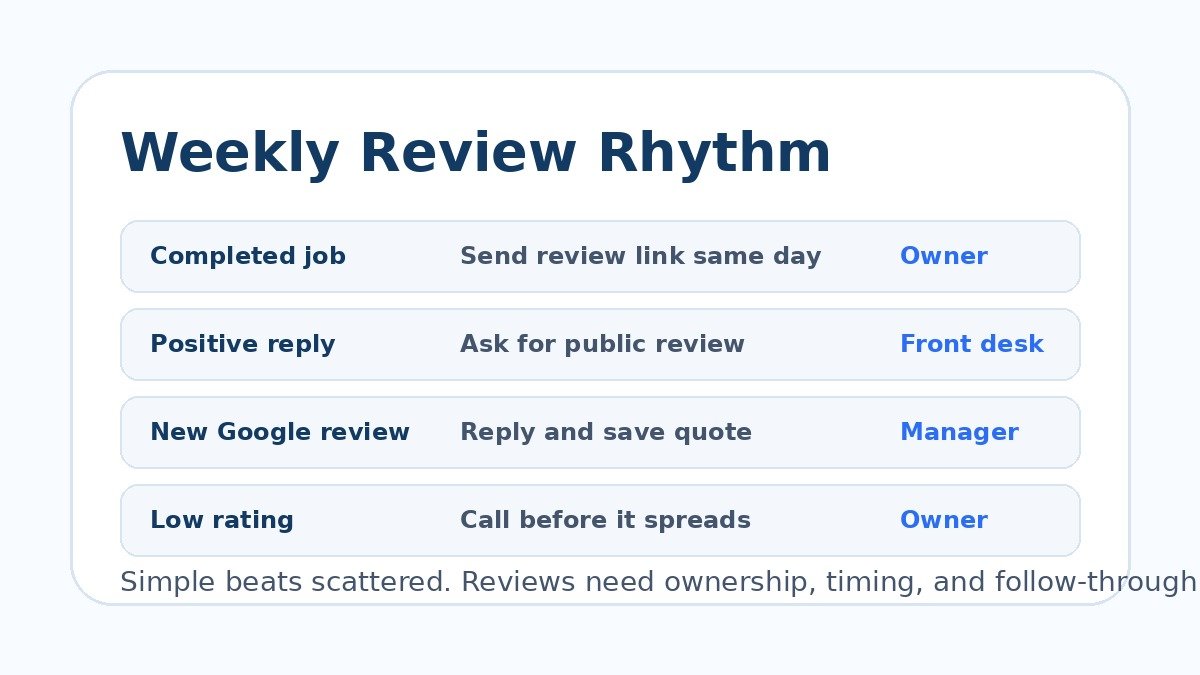
What a customer review system is
A customer review system is a repeatable process for collecting, responding to, and using customer feedback. It gives the team clear rules for when to ask, who asks, what message gets sent, and how reviews get handled after they appear.
Without a system, review collection depends on memory and mood. The busy weeks produce no requests. The quiet weeks produce panic. Someone remembers to ask one customer but forgets the next ten. That is how strong businesses end up looking average online.
A useful system is simple enough to run every week. It does not need a complicated software stack at the beginning. It needs a trigger, a message, a link, ownership, and a short review habit.
Why reviews matter for local lead generation
Reviews affect two buying moments. First, they help people decide which local business feels safe enough to contact. Second, they help search engines and map platforms understand whether real customers trust the business.
For a buyer comparing three companies, reviews often answer practical questions before the sales call starts:
- Does this business show up on time?
- Do customers mention clear communication?
- Are recent customers happy?
- Does the owner respond when something goes wrong?
- Do the reviews match the service the buyer needs?
That makes reviews part of the sales process, not just a reputation badge. A stronger review base can improve trust on the website, in ads, on local listings, in proposal follow-up, and in referral conversations.
Start with the right review trigger
The best time to ask is when the customer has just experienced the result. For a contractor, that may be after the final walkthrough. For a clinic, it may be after a successful appointment. For a consultant, it may be after a project milestone or measurable win.
Pick one clear trigger first:
- Job completed: send the request the same day the work is finished.
- Positive text or email: reply with appreciation and ask if they would share it publicly.
- Invoice paid: thank the customer and include the review link.
- Repeat purchase: ask loyal customers who already know the business well.
A trigger keeps the system fair. The team does not have to decide from scratch every time. When the event happens, the request goes out.
Use one clean review request message
A review request should be short, specific, and easy to act on. Customers are busy. If the message feels like homework, many happy people will skip it.
Here is a simple version:
Thanks again for choosing us. If the work was helpful, would you be willing to leave a quick Google review? It helps local customers find us and know what to expect. Here is the link: [review link]
That message works because it is polite, gives a reason, and points to one action. Avoid stuffing it with multiple platforms, long explanations, or emotional pressure.
Make negative feedback useful before it becomes public
A good review system should not only chase praise. It should also create a path for unhappy customers to be heard quickly.
One practical approach is to ask a private satisfaction question first after larger jobs: How did everything go? If the answer is positive, send the review link. If the answer shows a problem, call the customer and try to fix the issue before asking for anything public.
This is not about hiding criticism. It is about service recovery. Many bad reviews are preventable when the customer gets a real response before frustration spreads.
Assign review ownership
Review systems fail when everyone assumes someone else is handling them. Give the work a clear owner.
The owner should check three things each week:
- Which completed jobs or customer wins deserve a request?
- Which review requests were sent but never answered?
- Which new public reviews need a reply?
For a solo operator, this can be a 20-minute Friday task. For a small team, it can belong to the office manager, dispatcher, customer success person, or owner. The title matters less than the habit.
Reply to every public review
Replying shows future buyers that the business is active and attentive. Keep responses short and human. Mention the service when natural, thank the customer, and avoid sharing private details.
For positive reviews, use a simple response:
Thank you, Maria. We appreciate you trusting us with the repair and are glad the team made the process easy.
For critical reviews, stay calm:
Thank you for the feedback. We are sorry the experience did not meet expectations. Please contact us directly so we can review what happened and work toward a better resolution.
Do not argue online. Future buyers are watching the tone as much as the rating.
Use reviews across the business
Once reviews are collected, put the strongest language where buyers make decisions. Add a few current reviews to service pages, estimate follow-up emails, proposal documents, landing pages, and sales call notes.
If the business is also fixing missed calls, lead routing, or follow-up gaps, reviews become even more useful. A good next step is the missed-call follow-up system for local businesses, because trust matters most when a new lead is deciding who gets the call back.
For businesses using a customer relationship platform, a tool like the GoHighLevel guide can be worth reviewing when review requests, SMS follow-up, pipelines, and appointment reminders need to live in one place. The tool is optional. The process comes first.
A simple weekly review checklist
- List completed jobs, appointments, projects, or customer wins.
- Send review requests to the best-fit customers.
- Follow up once with people who said yes but did not post.
- Reply to every new public review.
- Save useful review quotes for sales and website copy.
- Call customers who left private negative feedback.
The checklist is small on purpose. A review system that runs every week beats a giant reputation project that gets ignored.
Common mistakes to avoid
- Asking too late: the customer has moved on and the emotion is gone.
- Sending too many choices: one clear review link usually works better.
- Ignoring replies: public silence can make the business look less attentive.
- Only asking perfect customers: the system should be honest and consistent.
- Buying or pressuring reviews: keep requests clean and compliant with platform rules.
FAQ
How often should a local business ask for reviews?
Ask whenever a clear positive customer moment happens, such as a completed job, successful appointment, paid invoice, or appreciative message. The habit should be consistent, not random.
Should review requests be sent by email or text?
Use the channel the customer already uses with the business. Text often gets faster action for local service companies, while email may fit consultants, clinics, and higher-detail relationships.
Can a business ask unhappy customers for reviews?
It is better to ask for private feedback first when the experience is uncertain. If there is a problem, focus on fixing it before asking for a public review.
Do reviews help SEO?
Reviews can support local visibility and click confidence, especially when they are recent, specific, and tied to real services. They are one signal among many, but they are also useful sales proof.
Bottom line
A customer review system does not need to be fancy. It needs to happen at the right moment, with one easy link, clear ownership, public replies, and a weekly habit. That is how local trust becomes visible before the next buyer makes a decision.
Want a clear next step?
Read the missed-call follow-up system ->